The Second Era year 2000 to 4000
The Early Years
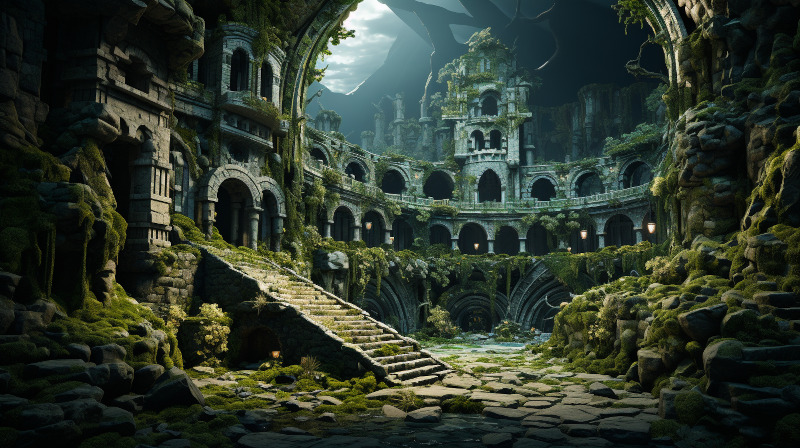
Figure 1: Lisse (meeting place) of an ancient Aelven city.
The Second Era in the annals of Naurrnen’s history, also known as the Age of Hallashim Ascendancy, was a time when High Aelves of Áyliaremma (the Hallashim) rose to unparalleled heights of intellectual, magical, and martial prowess. The High Aelves of Áyliaremma united the various Hallashim tribes into nation states, and then into mighty empires. The early years, the Áyliaremma Aelves were primarilly concerned with law. If they could find hints of the law of the Amearans, and decipher them, it was thought, they could build a great and just empire. This was the primary concern in exploring the lost civilization of Ameara.
The Áyliaremma Aelves became masterful linguists, pursuing the elusive Amearan tongue with a level of scholarly intensity unmatched in the realms of Naurrnen. With no existing Rosetta Stone to guide them, their efforts were nevertheless considerable. They spent decades poring over fragmented manuscripts, lost carvings, and puzzling artifacts, managing to develop the most detailed understanding of the ancient language ever achieved. It was through the use of magical Amearan artifacts, and how they interacted with certain words or phrases, that the Áyliaremma Aelves were able to formulate a limited, yet powerful dialect of the Amearan tongue.
One of the “discoveries” of the second era, was an etched stone, found in one of the Amearan ruins, that pictured Anashim with an enscription that was translated “Aelves”. The name stuck for scholars of the third era. Anashim are “Aelves” according to the translation of the etched stone. There is ongoing debate on validity of that translation.
While the Áyliaremma Aelves were scholars and linguists, they were also explorers and archaeologists, driven by an insatiable curiosity to uncover the forgotten treasures of the Amearan civilization. Several notable archaeological finds were attributed to their expeditions. Among them were mysterious relics of magic and lore, some of which hinted at levels of advancement far beyond the grasp of even the most enlightened Hallashim minds.
Descent into Absolutism
A clever and well connected statesman, by the name of Eldacar, began endorsing and employing his closest friends and allies, most of whom where his closest childhood friends. He created government positions for these friends, and slowly started to replace the current senate with them. They were young, ambitious, and cruel. The Aeritha laws encouraged, and even demanded that they share their discoveries with their brethren and the other races. At some uncertain point in time, it was decided by the senate that this sharing was no longer going to happen. The rulers of Aeritha became obsessed with discovery, and began forfeiting their regard for its laws. Eldacar, with the senate that had then become mostly populated by his childhood friends, became an absolute monarch of Aeritha. Eldacar, with support of his senate, began enslaving non-Aelven races.
The result was devastating. The discoveries that were found, were treated with the utmost secrecy, sheltered in hidden vaults and elite academic circles to prevent other races from gleaning their secrets. This form of academic elitism was symptomatic of a broader societal stratification that pervaded the mid-Second Era.
Militarily and politically, Aerithia stood as the zenith of Hallashim civilization during this age. Rooted in its rich academic tradition and fueled by its archaeological discoveries, Aerithia developed magical technologies that were instrumental in its eventual dominion over other Hallashim empires. Its armies were legendary, its magicians unparalleled, and its rulers both cunning and visionary. Under Aerithian rule, the disparate Hallashim nation-states were welded into a single, formidable empire. The capital, resplendent in its grandeur, became the heart of Naurrnen, a seat of power, wisdom, and unfortunately, inequality.
For beneath the shining accomplishments of the latter discovery-seeking Aerithian Aelves lay a more somber reality. The empire was transforming to that of a slave empire. They enslaved non-Aelven races, denied them access to education, magic, and any form of social upward mobility. While the Aelves reveled in their discoveries and advancements, the subjugated peoples languished in chains, both literal and metaphorical.
The Aelves of Áyliaremma desired to both preserve what they learned from the Amearans, and encrypt what they have learned to keep their secrets from being learned by the other races. One of the most famous tomes, was title “The Ameara” or the “The Ancient Ones”. In it is found a mixture of intriguing historical antedotes that may or may not be correct, tripe geographic details mixed with obscure poetry. The poetry is said to contain the secrets of the Amearans that the Aelves had learned. Falashas cryptic messages are just as lost to the Aelves of the third era, as it is to all the other races.
Bayetti Falasha was an elven scholar, dated as far back as the early to mid second era. She was a court scholar of the great Aeritha empire. She wrote many books on philosophy and poetry that are still used extensively and held in the highest regard amongst Anashim folk. Bayetti is, perhaps, the best known scholar of Naurnen’s ancient history.
Nearly a millenium later, Serinwe the Great (Serinwe the Terrible outside of Aeritha, and Serinwe the Paranoid by certain Hallashim scholars) took the throne in Aeritha. Fearing plots against his life, he summarilly executed some of his top military generals he suspected of treason. Unable to execute or enslave Justiciars he disliked, he resorted to systemically exhiling them to the outer provinces within the realm.
The Great Apostasy of 3695
Just five years after Serinwe the Terrible ascended the throne in Aeritha, in the year 3695, Serinwe forbade the other non-Hallashim Anashim from observing their rites of the Anashim pantheon. All rites were dictated by Serinwe and his corrupt senate.
The worship of the pantheon, once diverse and reflective of the various Aelven cultures, was now to be standardized and controlled exclusively according to the dictates of the council of Aeritha. This usurpation was not only a political maneuver but also a profound spiritual violation, deeply wounding the cultural and religious identity of all Aelves.
The enslavement of the other Anashim races began in earnest, a grim and tangible symbol of the new order’s cruelty and disregard for the sanctity of freedom and individual rights. It was during this dark time that the great Justicier Eolande Altherion, a figure of justice and law, boldly challenged Serinwe, the corrupt courts, and senate of Aeritha. His defiance, while noble, led to his exile, marking him as an enemy of the state but a beacon of hope for the oppressed.
Exiled but undeterred, Altherion’s influence continued to grow. He became an architect of resistance, teaching his knowledge and wisdom to those who would listen. Among those was a young slave, Thalion Veyreth, whom Altherion taught to read and write, imbuing him with the ancient laws and ideals of the Aelves. On his deathbed, Altherion granted Thalion his freedom, a final act of defiance and hope. Thalion Veyreth, inspired and equipped by Altherion’s teachings, went on to found the Moonlight Path, an underground network of resistance that would become the heartbeat of the Naethanor revolution centuries later.
This period, known ever after as the Great Apostasy, was characterized by tyranny, spiritual suppression, and the erosion of ancient liberties. Yet, it also planted the seeds of eventual resistance and revolution, as the oppressed clung to the memories of freedom and justice, awaiting the day they would reclaim their rightful heritage.